

How To Tell If A Boat Battery Is Bad
Many of our fishing techniques in Louisiana originated with our Indian anchestors.
When you fire up your computer and go a alarm message reading, "Hard Drive Failure Imminent," yous pretty well know what is about to happen. I chosen the local geek squad and was told that new smart drives perform a self diagnostic when a calculator boots up and let you know if something is wrong. It was fourth dimension to replace the hard bulldoze.
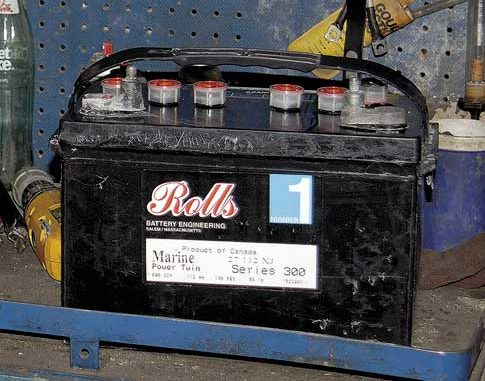
My boat'south cranking battery recently died, and while it
didn't upshot the stark alarm I got from the computer, it offered the following subtle hints that its wellness was failing.
Hint No. 1
I keep my boat in the garage with its onboard charger plugged in 24/seven, and every time I walk past the boat I look at the charger's indicator lights. I noticed that the battery was charging more than often than normal over the last calendar month of its life. Information technology would charge up normally later a trip, and then nigh every three or four days, the charger would kicking on once again to acme information technology off.
I confirmed that I had everything in the boat turned off, and while things like the engine'southward computer tin can go along to draw a tiny scrap of power with the key off, the battery used to handle it for weeks without triggering the charger. This made me worry that either the bombardment was losing its power to hold a charge or something had seriously reduced its storage capacity.
Hint No. ii
I keep my outboard trimmed full down in the garage to save room and make it easier to move the boat and trailer around without hitting annihilation. I trim it back up to a rubber towing peak earlier each trip to the lake.
I noticed that when the charger was disconnected, the trim motor seemed to run slower than usual, and information technology took longer to trim the outboard up to trailering position. The trim motor also seemed to run slower at the launch ramp as I trimmed the engine downwards before starting information technology.
Hint No. 3
When cranking the engine, the starter didn't seem to turn the engine over as fast as usual, although the engine starts then quickly this was hard to tell for certain. And the change in starter motor speed happened and so gradually that I didn't notice it until it got really wearisome.
Hint No. iv
Running the electronics while fishing seemed to run the bombardment down further than normal. I tin can usually run ii fish finder/GPS units for iii or four hours of line-fishing without dropping the cranking bombardment voltage more iii-tenths of a volt. The boat's volt meter reads about 12.9 volts afterwards I stopped the outboard and started angling. Three hours later it used to read around 12.6 volts. Information technology savage to around 12.4 volts the terminal few trips before the bombardment died.
Hint No. 5
Checking the electrolyte'southward specific gravity in each jail cell of a flooded battery is a messier but more authentic way to measure its state of charge than using a volt meter. I finally dragged out my hydrometer and checked the battery after the charger's lights all went greenish. Each jail cell read less than fully charged.
The final hint
The charger's lights were all green when I unplugged it to go to the lake, merely the power trim worked very slowly every bit I lowered the engine far enough to offset information technology. When I turned the primal, information technology couldn't rotate the engine a full revolution.
I took the battery to a local battery shop for a total set of tests. The news was bad: I was told information technology wouldn't accept a normal charge, it failed the load test, and while none of its cells were shorted, they were all weak. The battery was dead.
I should take taken the battery in for testing when it gave me the first hint that its health was failing. In fact, it isn't a bad idea to have an equalization charge done on a flooded battery (you can't exercise them on sealed batteries) once a season, forth with a set of health tests.
An equalization accuse is a advisedly controlled overcharge that brings weak cells support to a normal level without damaging healthy cells that are already there. Healthy cells make for a healthy bombardment.
Paying attention to your batteries won't keep them from sending you lot death notices sooner or later on, but it should keep them from coming as a surprise.
Source: https://www.louisianasportsman.com/fishing/dying-batteries-give-warning-signs/
0 Response to "How To Tell If A Boat Battery Is Bad"
Post a Comment