

Which Company Produced The First Cell Phone?

A mobile phone, cellular telephone, cell phone, cellphone, handphone, hand phone or pocket phone, sometimes shortened to simply mobile, cell, or just phone, is a portable phone that can make and receive calls over a radio frequency link while the user is moving within a phone service surface area. The radio frequency link establishes a connection to the switching systems of a mobile phone operator, which provides access to the public switched telephone network (PSTN). Modern mobile telephone services use a cellular network compages and, therefore, mobile telephones are called cellular telephones or cell phones in Due north America. In addition to telephony, digital mobile phones (2G) back up a diverseness of other services, such equally text messaging, MMS, electronic mail, Cyberspace admission, brusque-range wireless communications (infrared, Bluetooth), business applications, video games and digital photography. Mobile phones offering only those capabilities are known as characteristic phones; mobile phones which offer profoundly advanced calculating capabilities are referred to as smartphones.[1]
The development of metal-oxide-semiconductor (MOS) large-scale integration (LSI) technology, information theory and cellular networking led to the development of affordable mobile communications.[i] The first handheld mobile phone was demonstrated by Martin Cooper of Motorola in New York City in 1973, using a handset weighing c. 2 kilograms (4.4 lbs).[ii] In 1979, Nippon Telegraph and Phone (NTT) launched the earth'southward first cellular network in Japan.[three] In 1983, the DynaTAC 8000x was the commencement commercially available handheld mobile telephone. From 1983 to 2014, worldwide mobile phone subscriptions grew to over seven billion; enough to provide one for every person on Globe.[4] In the first quarter of 2016, the top smartphone developers worldwide were Samsung, Apple and Huawei; smartphone sales represented 78 percent of total mobile phone sales.[5] For feature phones (slang: "dumbphones") every bit of 2016[update], the tiptop-selling brands were Samsung, Nokia and Alcatel.[six]
Mobile phones are considered an important human invention every bit it has been one of the almost widely used and sold pieces of consumer technology.[7] The growth in popularity has been rapid in some places, for example in the Great britain the total number of mobile phones overtook the number of houses in 1999.[8] Today mobile phones are globally ubiquitous[nine] and in almost half the world'due south countries, over ninety% of the population ain at to the lowest degree 1.[10]
History

Martin Cooper of Motorola, shown here in a 2007 reenactment, made the first publicized handheld mobile phone call on a image DynaTAC model on 3 April 1973.
A handheld mobile radio telephone service was envisioned in the early stages of radio engineering. In 1917, Finnish inventor Eric Tigerstedt filed a patent for a "pocket-sized folding telephone with a very thin carbon microphone". Early predecessors of cellular phones included analog radio communications from ships and trains. The race to create truly portable telephone devices began after World War II, with developments taking place in many countries. The advances in mobile telephony have been traced in successive "generations", starting with the early zeroth-generation (0G) services, such as Bell System's Mobile Telephone Service and its successor, the Improved Mobile Phone Service. These 0G systems were not cellular, supported few simultaneous calls, and were very expensive.

The Motorola DynaTAC 8000X. In 1983, it became the first commercially bachelor handheld cellular mobile phone.
The development of metal-oxide-semiconductor (MOS) large-calibration integration (LSI) engineering, data theory and cellular networking led to the development of affordable mobile communications,[ane] and devices such every bit the car telephone. The offset handheld cellular mobile phone was demonstrated by John F. Mitchell[11] [12] and Martin Cooper of Motorola in 1973, using a handset weighing 2 kilograms (4.4 lb).[2] The first commercial automated cellular network (1G) analog was launched in Nippon by Nippon Telegraph and Telephone in 1979. This was followed in 1981 by the simultaneous launch of the Nordic Mobile Telephone (NMT) organisation in Kingdom of denmark, Finland, Norway, and Sweden.[13] Several other countries so followed in the early to mid-1980s. These showtime-generation (1G) systems could support far more than simultaneous calls just still used analog cellular engineering. In 1983, the DynaTAC 8000x was the offset commercially bachelor handheld mobile phone.
Digital cellular networks appeared in the 1990s, enabled by the wide adoption of MOSFET-based RF power amplifiers (power MOSFET and LDMOS) and RF circuits (RF CMOS),[14] [15] [16] leading to the introduction of digital bespeak processing in wireless communications.[1] In 1991, the second-generation (2G) digital cellular applied science was launched in Republic of finland by Radiolinja on the GSM standard. This sparked competition in the sector as the new operators challenged the incumbent 1G network operators. The GSM standard is a European initiative expressed at the CEPT ("Conférence Européenne des Postes et Telecommunications", European Postal and Telecommunication briefing). The Franco-High german R&D cooperation demonstrated the technical feasibility, and in 1987 a Memorandum of Agreement was signed betwixt xiii European countries who agreed to launch a commercial service by 1991. The first version of the GSM (=2G) standard had half-dozen,000 pages. The IEEE and RSE awarded to Thomas Haug and Philippe Dupuis the 2018 James Clerk Maxwell medal for their contributions to the start digital mobile telephone standard.[17] In 2018, the GSM was used past over 5 billion people in over 220 countries. The GSM (2G) has evolved into 3G, 4G and 5G. The standardisation body for GSM started at the CEPT Working Group GSM (Group Special Mobile) in 1982 nether the umbrella of CEPT. In 1988, ETSI was established and all CEPT standardization activities were transferred to ETSI. Working Group GSM became Technical Committee GSM. In 1991, it became Technical Commission SMG (Special Mobile Group) when ETSI tasked the committee with UMTS (3G).
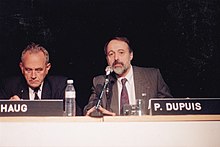
Dupuis and Haug during a GSM coming together in Belgium, April 1992
The lithium-ion bombardment, an indispensable energy source for mod mobile phones,[xviii] was commercialized past Sony and Asahi Kasei in 1991.[19] [20] In 2001, the third generation (3G) was launched in Japan by NTT DoCoMo on the WCDMA standard.[21] This was followed by three.5G, 3G+ or turbo 3G enhancements based on the high-speed packet access (HSPA) family, allowing UMTS networks to have higher data transfer speeds and capacity.
By 2009, information technology had get clear that, at some signal, 3G networks would exist overwhelmed by the growth of bandwidth-intensive applications, such as streaming media.[22] Consequently, the industry began looking to data-optimized fourth-generation technologies, with the promise of speed improvements up to 10-fold over existing 3G technologies. The first two commercially available technologies billed as 4G were the WiMAX standard, offered in North America past Sprint, and the LTE standard, first offered in Scandinavia by TeliaSonera.
5G is a technology and term used in research papers and projects to denote the next major phase in mobile telecommunication standards beyond the 4G/IMT-Advanced standards. The term 5G is not officially used in any specification or official document withal made public by telecommunication companies or standardization bodies such as 3GPP, WiMAX Forum or ITU-R. New standards beyond 4G are currently existence developed by standardization bodies, but they are at this time seen as under the 4G umbrella, not for a new mobile generation.
Types
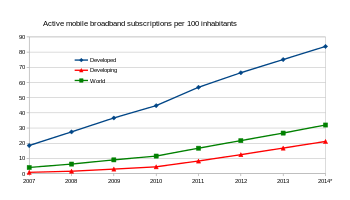
Agile mobile broadband subscriptions per 100 inhabitants.[23]
Smartphone
Smartphones take a number of distinguishing features. The International Telecommunications Union measures those with Cyberspace connectedness, which information technology calls Active Mobile-Broadband subscriptions (which includes tablets, etc.). In the adult earth, smartphones have at present overtaken the usage of earlier mobile systems. Still, in the developing earth, they account for around 50% of mobile telephony.
Characteristic phone
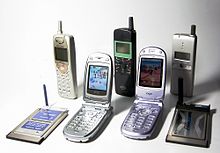
Feature phone is a term typically used as a retronym to describe mobile phones which are limited in capabilities in contrast to a modern smartphone. Feature phones typically provide vocalisation calling and text messaging functionality, in addition to bones multimedia and Net capabilities, and other services offered past the user'due south wireless service provider. A feature phone has additional functions over and higher up a bones mobile phone, which is simply capable of voice calling and text messaging.[24] [25] Characteristic phones and basic mobile phones tend to use a proprietary, custom-designed software and user interface. By contrast, smartphones generally use a mobile operating system that oftentimes shares common traits across devices.
Infrastructure

Cellular networks work by only reusing radio frequencies (in this example frequencies f1-f4) in not adjacent cells to avoid interference
Mobile phones communicate with cell towers that are placed to requite coverage beyond a telephone service expanse, which is divided upwardly into 'cells'. Each cell uses a different prepare of frequencies from neighboring cells, and volition typically be covered past iii towers placed at unlike locations. The jail cell towers are commonly interconnected to each other and the telephone network and the internet past wired connections. Due to bandwidth limitations each cell will take a maximum number of cell phones information technology can handle at once. The cells are therefore sized depending on the expected usage density, and may exist much smaller in cities. In that instance much lower transmitter powers are used to avoid broadcasting across the jail cell.
In order to handle the high traffic, multiple towers can be ready in the same area (using different frequencies). This tin can be done permanently or temporarily such as at special events like at the Super Bowl, Taste of Chicago, State Off-white, NYC New Year's Eve, hurricane hitting cities, etc. where cell phone companies will bring a truck with equipment to host the abnormally high traffic with a portable jail cell.
Cellular can greatly increase the capacity of simultaneous wireless phone calls. While a phone company for case, has a license to 1,000 frequencies, each cell must use unique frequencies with each phone call using one of them when communicating. Because cells merely slightly overlap, the aforementioned frequency tin exist reused. Example cell one uses frequency 1–500, adjacent door cell uses frequency 501–1,000, side by side door can reuse frequency 1–500. Cells 1 and three are not "touching" and do not overlap/communicate then each tin can reuse the same frequencies.[ citation needed ]
Capacity was further increased when phone companies implemented digital networks. With digital, i frequency can host multiple simultaneous calls.
As a phone moves around, a phone will "hand off" - automatically disconnect and reconnect to the tower of another prison cell that gives the best reception.
Additionally, short-range Wi-Fi infrastructure is oftentimes used by smartphones as much as possible as information technology offloads traffic from prison cell networks on to local area networks.
Hardware
The common components found on all mobile phones are:
- A central processing unit (CPU), the processor of phones. The CPU is a microprocessor fabricated on a metal–oxide–semiconductor (MOS) integrated circuit (IC) chip.
- A bombardment, providing the power source for the phone functions. A modern handset typically uses a lithium-ion battery (LIB), whereas older handsets used nickel–metal hydride (Ni–MH) batteries.
- An input mechanism to allow the user to interact with the phone. These are a keypad for feature phones, and touch screens for most smartphones (typically with capacitive sensing).
- A brandish which echoes the user's typing, and displays text messages, contacts, and more. The display is typically either a liquid-crystal display (LCD) or organic light-emitting diode (OLED) brandish.
- Speakers for sound.
- Subscriber identity module (SIM) cards and removable user identity module (R-UIM) cards.
- A hardware notification LED on some phones
Depression-end mobile phones are ofttimes referred to as feature phones and offer bones telephony. Handsets with more advanced computing ability through the use of native software applications are known every bit smartphones.
Central processing unit
Mobile phones have key processing units (CPUs), similar to those in computers, simply optimised to operate in depression ability environments.
Mobile CPU performance depends not only on the clock rate (by and large given in multiples of hertz)[26] but also the memory hierarchy also greatly affects overall performance. Considering of these problems, the operation of mobile phone CPUs is often more appropriately given past scores derived from various standardized tests to measure out the real effective performance in usually used applications.
Display
I of the principal characteristics of phones is the screen. Depending on the device'southward type and design, the screen fills most or nearly all of the space on a device's front surface. Many smartphone displays have an attribute ratio of 16:9, but taller attribute ratios became more common in 2017.
Screen sizes are often measured in diagonal inches or millimeters; characteristic phones generally take screen sizes below 90 millimetres (3.5 in). Phones with screens larger than 130 millimetres (v.ii in) are often called "phablets." Smartphones with screens over 115 millimetres (4.v in) in size are ordinarily difficult to employ with only a single paw, since most thumbs cannot reach the unabridged screen surface; they may need to be shifted effectually in the hand, held in i hand and manipulated by the other, or used in place with both easily. Due to design advances, some modern smartphones with large screen sizes and "edge-to-border" designs accept compact builds that ameliorate their ergonomics, while the shift to taller aspect ratios have resulted in phones that have larger screen sizes whilst maintaining the ergonomics associated with smaller 16:9 displays.[27] [28] [29]
Liquid-crystal displays are the virtually common; others are IPS, LED, OLED, and AMOLED displays. Some displays are integrated with force per unit area-sensitive digitizers, such as those developed past Wacom and Samsung,[30] and Apple'due south "3D Touch on" system.
Sound
In sound, smartphones and characteristic phones vary little. Some audio-quality enhancing features, such every bit Voice over LTE and Hard disk drive Voice, accept appeared and are oftentimes available on newer smartphones. Sound quality tin can remain a trouble due to the design of the telephone, the quality of the cellular network and compression algorithms used in long-distance calls.[31] [32] Audio quality can be improved using a VoIP application over WiFi.[33] Cellphones accept small-scale speakers so that the user can utilise a speakerphone feature and talk to a person on the telephone without holding it to their ear. The pocket-sized speakers can also be used to listen to digital audio files of music or speech or watch videos with an audio component, without belongings the phone close to the ear.
Bombardment
The average phone bombardment lasts 2–3 years at best. Many of the wireless devices use a Lithium-Ion (Li-Ion) battery, which charges 500–2500 times, depending on how users have care of the battery and the charging techniques used.[34] It is only natural for these rechargeable batteries to chemically historic period, which is why the operation of the bombardment when used for a year or two will brainstorm to deteriorate. Battery life can be extended past draining it regularly, not overcharging it, and keeping it away from estrus.[35] [36]
SIM carte

Mobile phones crave a small microchip called a Subscriber Identity Module or SIM card, in order to part. The SIM carte is approximately the size of a small stamp postage and is commonly placed underneath the battery in the rear of the unit of measurement. The SIM securely stores the service-subscriber central (IMSI) and the Chiliadi used to identify and authenticate the user of the mobile phone. The SIM menu allows users to change phones by but removing the SIM card from one mobile phone and inserting it into another mobile phone or broadband telephony device, provided that this is not prevented by a SIM lock. The first SIM card was made in 1991 by Munich smart card maker Giesecke & Devrient for the Finnish wireless network operator Radiolinja.[ citation needed ]
A hybrid mobile phone can hold upwards to four SIM cards, with a phone having a different device identifier for each SIM Card. SIM and R-UIM cards may be mixed together to allow both GSM and CDMA networks to be accessed. From 2010 onwards, such phones became popular in emerging markets,[37] and this was attributed to the want to obtain the lowest calling costs.
When the removal of a SIM card is detected by the operating system, it may deny further operation until a reboot.[38]
Software
Software platforms

![[icon]](https://upload.wikimedia.org/wikipedia/commons/thumb/1/1c/Wiki_letter_w_cropped.svg/20px-Wiki_letter_w_cropped.svg.png) | This section needs expansion. You lot tin assist by calculation to it. (Oct 2018) |
Characteristic phones have basic software platforms. Smartphones accept advanced software platforms. Android Bone has been the acknowledged OS worldwide on smartphones since 2011.
Mobile app
A mobile app is a reckoner plan designed to run on a mobile device, such as a smartphone. The term "app" is a shortening of the term "software application".
- Messaging
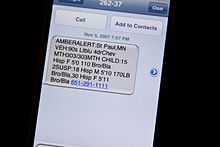
A common information application on mobile phones is Short Message Service (SMS) text messaging. The showtime SMS message was sent from a reckoner to a mobile phone in 1992 in the Great britain while the commencement person-to-person SMS from phone to phone was sent in Republic of finland in 1993. The first mobile news service, delivered via SMS, was launched in Finland in 2000,[39] and afterward many organizations provided "on-demand" and "instant" news services by SMS. Multimedia Messaging Service (MMS) was introduced in March 2002.[40]
Application stores
The introduction of Apple's App Store for the iPhone and iPod Touch in July 2008 popularized manufacturer-hosted online distribution for third-party applications (software and computer programs) focused on a single platform. There are a huge variety of apps, including video games, music products and business tools. Up until that indicate, smartphone application distribution depended on third-party sources providing applications for multiple platforms, such equally GetJar, Handango, Handmark, and PocketGear. Following the success of the App Store, other smartphone manufacturers launched application stores, such as Google'southward Android Market (after renamed to the Google Play Shop), RIM's BlackBerry App World, or Android-related app stores like Aptoide, Cafe Bazaar, F-Droid, GetJar, and Opera Mobile Shop. In February 2014, 93% of mobile developers were targeting smartphones first for mobile app development.[41]
Sales
By manufacturer
| Rank | Manufacturer | Strategy Analytics report[42] | ||
|---|---|---|---|---|
| one | Samsung | 21% | ||
| 2 | Apple | 16% | ||
| 3 | Xiaomi | 13% | ||
| four | Oppo | 10% | ||
| 5 | Vivo | 9% | ||
| Others | 31% | |||
| Note: Vendor shipments are branded shipments and exclude OEM sales for all vendors. | ||||
As of 2022, the height five manufacturers worldwide were Samsung (21%), Apple (16%), Xiaomi (xiii%), Oppo (10%), and Vivo (nine%).[43]
- History
From 1983 to 1998, Motorola was market leader in mobile phones. Nokia was the marketplace leader in mobile phones from 1998 to 2012.[44] In Q1 2012, Samsung surpassed Nokia, selling 93.5 meg units as against Nokia's 82.7 million units. Samsung has retained its tiptop position since and then.
Aside from Motorola, European brands such as Nokia, Siemens and Ericsson once held large sway over the global mobile telephone market place, and many new technologies were pioneered in Europe. By 2010, the influence of European companies had significantly decreased due to violent competition from American and Asian companies, to where most technical innovation had shifted.[45] [46] Apple tree and Google, both of the United States, also came to dominate mobile phone software.[45]
By mobile phone operator
The world's largest private mobile operator by number of subscribers is China Mobile, which has over 902 1000000 mobile phone subscribers equally of June 2018[update].[47] Over 50 mobile operators have over ten million subscribers each, and over 150 mobile operators had at to the lowest degree one million subscribers by the end of 2009.[48] In 2014, there were more than seven billion mobile phone subscribers worldwide, a number that is expected to proceed growing.
Use

Mobile telephone subscribers per 100 inhabitants. 2014 effigy is estimated.
Mobile phones are used for a variety of purposes, such equally keeping in bear on with family members, for conducting business, and in order to have admission to a telephone in the result of an emergency. Some people carry more than than one mobile phone for different purposes, such as for business organisation and personal utilize. Multiple SIM cards may exist used to take reward of the benefits of different calling plans. For example, a particular plan might provide for cheaper local calls, long-distance calls, international calls, or roaming.
The mobile phone has been used in a variety of diverse contexts in society. For example:
- A report past Motorola found that one in ten mobile telephone subscribers have a second phone that is often kept secret from other family members. These phones may be used to engage in such activities every bit extramarital affairs or surreptitious concern dealings.[49]
- Some organizations assist victims of domestic violence past providing mobile phones for use in emergencies. These are oftentimes refurbished phones.[50]
- The advent of widespread text-messaging has resulted in the prison cell telephone novel, the first literary genre to emerge from the cellular age, via text messaging to a website that collects the novels every bit a whole.[51]
- Mobile telephony also facilitates activism and citizen journalism.
- The United nations reported that mobile phones take spread faster than whatever other form of technology and tin ameliorate the livelihood of the poorest people in developing countries, by providing access to data in places where landlines or the Internet are not bachelor, especially in the least developed countries. Use of mobile phones likewise spawns a wealth of micro-enterprises, by providing such piece of work as selling airtime on the streets and repairing or refurbishing handsets.[52]
- In Mali and other African countries, people used to travel from village to village to allow friends and relatives know about weddings, births, and other events. This can now exist avoided in areas with mobile telephone coverage, which are usually more than all-encompassing than areas with merely land-line penetration.
- The Tv set industry has recently started using mobile phones to drive alive Tv viewing through mobile apps, advertisement, social Tv set, and mobile TV.[53] Information technology is estimated that 86% of Americans use their mobile telephone while watching TV.
- In some parts of the world, mobile phone sharing is common. Jail cell telephone sharing is prevalent in urban Republic of india, as families and groups of friends oft share one or more than mobile phones amidst their members. There are obvious economic benefits, but oft familial community and traditional gender roles play a role.[54] Information technology is common for a hamlet to accept access to only one mobile phone, peradventure endemic by a instructor or missionary, which is bachelor to all members of the village for necessary calls.[55]
Content distribution
In 1998, ane of the get-go examples of distributing and selling media content through the mobile telephone was the sale of ringtones by Radiolinja in Finland. Soon later, other media content appeared, such as news, video games, jokes, horoscopes, TV content and advertizement. Almost early content for mobile phones tended to be copies of legacy media, such as banner advertisements or Television set news highlight video clips. Recently, unique content for mobile phones has been emerging, from ringtones and ringback tones to mobisodes, video content that has been produced exclusively for mobile phones.[ citation needed ]
Mobile cyberbanking and payment
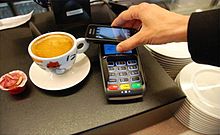
In many countries, mobile phones are used to provide mobile cyberbanking services, which may include the ability to transfer cash payments past secure SMS text message. Republic of kenya's M-PESA mobile banking service, for example, allows customers of the mobile phone operator Safaricom to agree greenbacks balances which are recorded on their SIM cards. Greenbacks can be deposited or withdrawn from Thou-PESA accounts at Safaricom retail outlets located throughout the country and tin be transferred electronically from person to person and used to pay bills to companies.
Branchless banking has also been successful in Southward Africa and the Philippines. A airplane pilot project in Bali was launched in 2011 by the International Finance Corporation and an Indonesian bank, Bank Mandiri.[56]
Mobile payments were start trialled in Finland in 1998 when two Coca-Cola vending machines in Espoo were enabled to work with SMS payments. Eventually, the thought spread and in 1999, the Philippines launched the country's first commercial mobile payments systems with mobile operators Earth and Smart.[ commendation needed ]
Some mobile phones can make mobile payments via straight mobile billing schemes, or through contactless payments if the telephone and the indicate of sale back up nigh field communication (NFC).[57] Enabling contactless payments through NFC-equipped mobile phones requires the co-operation of manufacturers, network operators, and retail merchants.[58] [59]
Mobile tracking
Mobile phones are commonly used to collect location data. While the phone is turned on, the geographical location of a mobile phone can be determined easily (whether information technology is beingness used or not) using a technique known as multilateration to summate the differences in time for a signal to travel from the mobile phone to each of several jail cell towers nigh the owner of the phone.[60] [61]
The movements of a mobile phone user can be tracked past their service provider and, if desired, by constabulary enforcement agencies and their governments. Both the SIM carte du jour and the handset tin exist tracked.[60]
China has proposed using this technology to rails the commuting patterns of Beijing city residents.[62] In the UK and The states, police force enforcement and intelligence services use mobile phones to perform surveillance operations.[63]
Hackers have been able to rails a phone'south location, read messages, and record calls, through obtaining a subscribers telephone number.[64]
While driving

A driver using two handheld mobile phones at once

A sign in the U.S. restricting jail cell phone employ to certain times of twenty-four hours (no jail cell phone use betwixt 7:30am-9:00am and 2:00pm-4:15pm)
Mobile phone use while driving, including talking on the telephone, texting, or operating other phone features, is common but controversial. It is widely considered dangerous due to distracted driving. Being distracted while operating a motor vehicle has been shown to increase the risk of accidents. In September 2010, the US National Highway Traffic Safety Administration (NHTSA) reported that 995 people were killed past drivers distracted past cell phones. In March 2011, a U.S. insurance company, State Farm Insurance, announced the results of a study which showed 19% of drivers surveyed accessed the Net on a smartphone while driving.[65] Many jurisdictions prohibit the employ of mobile phones while driving. In Egypt, State of israel, Nippon, Portugal, and Singapore, both handheld and hands-free utilise of a mobile phone (which uses a speakerphone) is banned. In other countries, including the Uk and France and in many U.S. states, only handheld phone employ is banned while easily-free utilise is permitted.
A 2011 study reported that over 90% of higher students surveyed text (initiate, respond or read) while driving.[66] The scientific literature on the dangers of driving while sending a text bulletin from a mobile phone, or texting while driving, is limited. A simulation study at the University of Utah establish a sixfold increase in lark-related accidents when texting.[67]
Due to the increasing complication of mobile phones, they are often more like mobile computers in their available uses. This has introduced additional difficulties for law enforcement officials when attempting to distinguish 1 usage from another in drivers using their devices. This is more apparent in countries which ban both handheld and easily-gratis usage, rather than those which ban handheld utilise only, as officials cannot hands tell which function of the mobile telephone is being used simply by looking at the driver. This tin can lead to drivers existence stopped for using their device illegally for a phone telephone call when, in fact, they were using the device legally, for instance, when using the telephone's incorporated controls for car stereo, GPS or satnav.
A 2010 study reviewed the incidence of mobile phone use while cycling and its effects on behaviour and safety.[68] In 2013, a national survey in the U.s. reported the number of drivers who reported using their cellphones to access the Internet while driving had risen to nigh one of iv.[69] A study conducted by the Academy of Vienna examined approaches for reducing inappropriate and problematic utilise of mobile phones, such as using mobile phones while driving.[70]
Accidents involving a commuter beingness distracted by talking on a mobile telephone have begun to be prosecuted as negligence similar to speeding. In the U.k., from 27 February 2007, motorists who are caught using a hand-held mobile phone while driving will have three penalization points added to their license in addition to the fine of £60.[71] This increase was introduced to endeavour to stem the increase in drivers ignoring the police.[72] Japan prohibits all mobile telephone apply while driving, including apply of hands-gratuitous devices. New Zealand has banned manus-held prison cell phone apply since i November 2009. Many states in the U.s.a. have banned texting on cell phones while driving. Illinois became the 17th American land to enforce this law.[73] As of July 2010[update], 30 states had banned texting while driving, with Kentucky condign the most contempo add-on on 15 July.[74]
Public Health Constabulary Enquiry maintains a list of distracted driving laws in the United States. This database of laws provides a comprehensive view of the provisions of laws that restrict the use of mobile communication devices while driving for all l states and the District of Columbia betwixt 1992 when first law was passed, through 1 December 2010. The dataset contains information on 22 dichotomous, continuous or chiselled variables including, for case, activities regulated (e.g., texting versus talking, hands-complimentary versus handheld), targeted populations, and exemptions.[75]
In 2010, an estimated 1500 pedestrians were injured in the US while using a cellphone and some jurisdictions have attempted to ban pedestrians from using their cellphones.[76] [77]
Health effects
The effect of mobile phone radiation on human health is the subject of recent[ when? ] interest and study, as a result of the enormous increase in mobile phone usage throughout the world. Mobile phones apply electromagnetic radiation in the microwave range, which some believe may be harmful to human being wellness. A big torso of research exists, both epidemiological and experimental, in non-human animals and in humans. The majority of this research shows no definite causative human relationship between exposure to mobile phones and harmful biological effects in humans. This is often paraphrased simply as the balance of evidence showing no damage to humans from mobile phones, although a significant number of individual studies practise suggest such a human relationship, or are inconclusive. Other digital wireless systems, such every bit data communication networks, produce similar radiation.[ citation needed ]
On 31 May 2011, the World Wellness Organization stated that mobile phone use may perhaps represent a long-term health take chances,[78] [79] classifying mobile phone radiations every bit "possibly carcinogenic to humans" afterward a team of scientists reviewed studies on mobile telephone safe.[lxxx] The mobile phone is in category 2B, which ranks it alongside java and other possibly carcinogenic substances.[81] [82]
Some recent[ when? ] studies accept found an association between mobile telephone use and sure kinds of encephalon and salivary gland tumors. Lennart Hardell and other authors of a 2009 meta-analysis of xi studies from peer-reviewed journals concluded that cell phone usage for at to the lowest degree ten years "approximately doubles the risk of existence diagnosed with a brain tumor on the same ('ipsilateral') side of the head as that preferred for cell phone utilize".[83]
One study of past mobile phone employ cited in the study showed a "forty% increased risk for gliomas (brain cancer) in the highest category of heavy users (reported boilerplate: 30 minutes per solar day over a 10‐year menses)".[84] This is a reversal of the written report's prior position that cancer was unlikely to be caused past cellular phones or their base stations and that reviews had institute no disarming testify for other health effects.[79] [85] However, a report published 24 March 2012, in the British Medical Journal questioned these estimates because the increase in brain cancers has not paralleled the increase in mobile phone use.[86] Certain countries, including France, have warned against the apply of mobile phones by minors in item, due to health chance uncertainties.[87] Mobile pollution by transmitting electromagnetic waves tin exist decreased up to xc% by adopting the circuit as designed in mobile phone and mobile exchange.[88]
In May 2016, preliminary findings of a long-term written report past the U.S. regime suggested that radio-frequency (RF) radiation, the type emitted by cell phones, can cause cancer.[89] [ninety]
Educational impact
A written report by the London Schoolhouse of Economics found that banning mobile phones in schools could increase pupils' bookish functioning, providing benefits equal to one extra week of schooling per twelvemonth.[91]
Electronic waste matter regulation
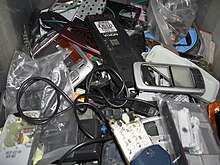
Studies have shown that effectually twoscore–50% of the environmental bear upon of mobile phones occurs during the manufacture of their printed wiring boards and integrated circuits.[92]
The average user replaces their mobile phone every 11 to 18 months,[93] and the discarded phones then contribute to electronic waste. Mobile phone manufacturers within Europe are subject area to the WEEE directive, and Australia has introduced a mobile phone recycling scheme.[94]
Apple Inc. had an advanced robotic disassembler and sorter chosen Liam specifically for recycling outdated or broken iPhones.[95]
Theft
According to the Federal Communications Commission, one out of three robberies involve the theft of a cellular phone.[ citation needed ] Police data in San Francisco show that half of all robberies in 2012 were thefts of cellular phones.[ citation needed ] An online petition on Modify.org, chosen Secure our Smartphones, urged smartphone manufacturers to install kill switches in their devices to make them unusable if stolen. The petition is role of a joint effort by New York Chaser General Eric Schneiderman and San Francisco District Attorney George Gascón and was directed to the CEOs of the major smartphone manufacturers and telecommunication carriers.[96] On ten June 2013, Apple announced that information technology would install a "kill switch" on its next iPhone operating system, due to debut in October 2013.[97]
All mobile phones have a unique identifier called IMEI. Anyone tin report their telephone every bit lost or stolen with their Telecom Carrier, and the IMEI would exist blacklisted with a central registry.[98] Telecom carriers, depending upon local regulation tin or must implement blocking of blacklisted phones in their network. In that location are, yet, a number of means to circumvent a blacklist. One method is to send the phone to a country where the telecom carriers are not required to implement the blacklisting and sell it there,[99] another involves altering the telephone's IMEI number.[100] Even so, mobile phones typically have less value on the second-hand market if the phones original IMEI is blacklisted.
Conflict minerals
Need for metals used in mobile phones and other electronics fuelled the 2nd Congo War, which claimed almost five.5 million lives.[101] In a 2012 news story, The Guardian reported: "In unsafe mines deep underground in eastern Congo, children are working to extract minerals essential for the electronics industry. The profits from the minerals finance the bloodiest disharmonize since the second globe state of war; the war has lasted nearly twenty years and has recently flared up again. For the last 15 years, the Autonomous Republic of the Congo has been a major source of natural resources for the mobile phone manufacture."[102] The company Fairphone has worked to develop a mobile phone that does not comprise conflict minerals.[ citation needed ]
Kosher phones
Due to concerns by the Orthodox Jewish rabbinate in Britain that texting by youths could waste product time and lead to "immodest" communication, the rabbinate recommended that phones with text-messaging adequacy not be used by children; to address this, they gave their official approval to a make of "Kosher" phones with no texting capabilities. Although these phones are intended to prevent immodesty, some vendors report adept sales to adults who prefer the simplicity of the devices; other Orthodox Jews question the need for them.[103]
In Israel, similar phones to kosher phones with restricted features be to observe the sabbath; under Orthodox Judaism, the utilize of any electrical device is generally prohibited during this time, other than to save lives, or reduce the risk of death or like needs. Such phones are approved for utilize by essential workers, such as wellness, security, and public service workers.[104]
See too
- Cellular frequencies
- Customer proprietary network data
- Field telephone
- List of countries by number of mobile phones in use
- Mobile broadband
- Mobile Internet device (MID)
- Mobile phone accessories
- Mobile phones on aircraft
- Mobile phone use in schools
- Mobile engineering
- Mobile telephony
- Mobile telephone form factor
- Optical caput-mounted display
- OpenBTS
- Pager
- Personal digital banana
- Personal Handy-phone System
- Prepaid mobile phone
- Two-fashion radio
- Professional mobile radio
- Push button-push button phone
- Rechargeable battery
- Smombie
- Surveillance
- Tethering
- VoIP phone
References
- ^ a b c d Srivastava, Viranjay M.; Singh, Ghanshyam (2013). MOSFET Technologies for Double-Pole Four-Throw Radio-Frequency Switch. Springer Science & Business Media. p. 1. ISBN9783319011653.
- ^ a b Teixeira, Tania (23 Apr 2010). "Run into the man who invented the mobile telephone". BBC News . Retrieved ii July 2021.
- ^ "Timeline from 1G to 5G: A Brief History on Cell Phones". CENGN. 21 September 2020. Retrieved eighteen Feb 2022.
- ^ "Mobile penetration". 9 July 2010.
Nearly 40 percent of the globe'southward population, 2.7 billion people, are online. The developing world is dwelling to about 826 million female internet users and 980 million male cyberspace users. The developed globe is home to nearly 475 1000000 female Internet users and 483 million male Internet users.
- ^ "Gartner Says Worldwide Smartphone Sales Grew 3.9 Percent in First Quarter of 2016". Gartner. Archived from the original on 22 May 2016. Retrieved 21 May 2016.
- ^ "Nokia Captured 9% Feature Telephone Marketshare Worldwide in 2016". Strategyanalytics.com. 24 Feb 2017. Retrieved 7 September 2018.
- ^ Harris, Arlene; Cooper, Martin (2019). "Mobile phones: Impacts, challenges, and predictions". Homo Beliefs and Emerging Technologies. ane: fifteen–17. doi:ten.1002/hbe2.112. S2CID 187189041.
- ^ "BBC News | BUSINESS | Mobile phone sales surge".
- ^ Gupta, Gireesh K. (2011). "Ubiquitous mobile phones are becoming indispensable". ACM Inroads. 2 (two): 32–33. doi:10.1145/1963533.1963545. S2CID 2942617.
- ^ "Mobile phones are condign ubiquitous". International Telecommunications Union (ITU). 17 Feb 2022.
- ^ John F. Mitchell Biography
- ^ Who invented the prison cell telephone?
- ^ "Swedish National Museum of Science and Technology". Tekniskamuseet.se. Archived from the original on 22 October 2008. Retrieved 29 July 2009.
- ^ Baliga, B. Jayant (2005). Silicon RF Power MOSFETS. Earth Scientific. ISBN9789812561213.
- ^ Asif, Saad (2018). 5G Mobile Communications: Concepts and Technologies. CRC Press. pp. 128–134. ISBN9780429881343.
- ^ O'Neill, A. (2008). "Asad Abidi Recognized for Work in RF-CMOS". IEEE Solid-Land Circuits Club Newsletter. 13 (1): 57–58. doi:ten.1109/North-SSC.2008.4785694. ISSN 1098-4232.
- ^ "Duke of Cambridge Presents Maxwell Medals to GSM Developers". IEEE United Kingdom and Ireland Section. i September 2018. Retrieved 10 December 2020.
- ^ Williams, R. K.; Darwish, 1000. Northward.; Blanchard, R. A.; Siemieniec, R.; Rutter, P.; Kawaguchi, Y. (2017). "The Trench Power MOSFET—Part 2: Application Specific VDMOS, LDMOS, Packaging, and Reliability". IEEE Transactions on Electron Devices. 64 (3): 692–712. Bibcode:2017ITED...64..692W. doi:ten.1109/TED.2017.2655149. ISSN 0018-9383. S2CID 38550249.
- ^ "Keywords to agreement Sony Energy Devices – keyword 1991". Archived from the original on iv March 2016.
- ^ "IEEE Medal for Environmental and Safety Technologies Recipients". IEEE Medal for Environmental and Safety Technologies. Institute of Electric and Electronics Engineers. Retrieved 29 July 2019.
- ^ "History of UMTS and 3G Development". Umtsworld.com . Retrieved 29 July 2009.
- ^ Fahd Ahmad Saeed. "Capacity Limit Problem in 3G Networks". Purdue School of Technology. Retrieved 23 April 2010.
- ^ "Statistics". ITU.
- ^ "feature telephone Definition from PC Magazine Encyclopedia". world wide web.pcmag.com.
- ^ Todd Hixon, 2 Weeks With A Dumb Phone, Forbes, 13 November 2012
- ^ "CPU Frequency". CPU Earth Glossary. CPU Earth. 25 March 2008. Retrieved i January 2010.
- ^ "Don't call information technology a phablet: the 5.five" Samsung Milky way S7 Edge is narrower than many 5.2" devices". PhoneArena . Retrieved three April 2017.
- ^ "We're gonna need Pythagoras' help to compare screen sizes in 2017". The Verge. 30 March 2017. Retrieved 3 April 2017.
- ^ "The Samsung Galaxy S8 will change the way nosotros recall about display sizes". The Verge. Vox Media. 30 March 2017. Retrieved 3 April 2017.
- ^ Ward, J. R.; Phillips, M. J. (1 Apr 1987). "Digitizer Technology: Functioning Characteristics and the Effects on the User Interface". IEEE Computer Graphics and Applications. seven (4): 31–44. doi:x.1109/MCG.1987.276869. ISSN 0272-1716. S2CID 16707568.
- ^ Jeff Hecht (30 September 2014). "Why Mobile Voice Quality Still Stinks—and How to Fix It". ieee.org.
- ^ Elena Malykhina. "Why Is Cell Phone Call Quality So Terrible?". scientificamerican.com.
- ^ Alan Henry (22 May 2014). "What's the All-time Mobile VoIP App?". Lifehacker. Gawker Media.
- ^ Taylor, Martin. "How To Prolong Your Cell Telephone Battery'southward Life Span". Phonedog.com . Retrieved viii June 2018.
- ^ "Iphone Battery and Performance". Apple Support . Retrieved 8 June 2018.
- ^ Hill, Simon. "Should You lot Leave Your Smartphone Plugged Into The Charger Overnight? We Asked An Skillful". Digital Trends . Retrieved 8 June 2018.
- ^ "Smartphone smash lifts phone market in offset quarter". Reuters. 29 April 2011. Archived from the original on eight May 2011. Retrieved 6 May 2019.
- ^ "How to Set 'No SIM Card Detected' Error on Android". Make Tech Easier. 20 September 2020.
- ^ Lynn, Natalie (ten March 2016). "The History and Evolution of Mobile Advertising". Gimbal . Retrieved three Oct 2021.
- ^ Bodic, Gwenaël Le (viii July 2005). Mobile Messaging Technologies and Services: SMS, Ems and MMS. John Wiley & Sons. ISBN978-0-470-01451-6.
- ^ W3C Interview: Vision Mobile on the App Developer Economic system with Matos Kapetanakis and Dimitris Michalakos Archived 29 June 2016 at the Wayback Machine. xviii February 2014. Retrieved 24 Feb 2015.
- ^ "Global Smartphone Marketplace Share: By Quarter". Counterpoint Research. 24 Baronial 2022. Retrieved 28 August 2022.
- ^ "Global Smartphone Marketplace Share: By Quarter". Counterpoint Research. 24 Baronial 2022. Retrieved 28 August 2022.
- ^ Cheng, Roger. "Farewell Nokia: The rise and fall of a mobile pioneer". CNET.
- ^ a b "How the smartphone made Europe look stupid". the Guardian. 14 February 2010.
- ^ Mobility, Yomi Adegboye AKA Mister (5 February 2020). "Non-Chinese smartphones: These phones are non fabricated in China - MobilityArena.com". mobilityarena.com.
- ^ "Operation Information". China Mobile. 31 August 2017.
- ^ Source: wireless intelligence
- ^ "Millions go on hole-and-corner mobile". BBC News. 16 October 2001. Retrieved 4 Nov 2009.
- ^ Brooks, Richard (thirteen Baronial 2007). "Donated cell phones aid battered women". The Press-Enterprise. Archived from the original on 25 September 2009. Retrieved four Nov 2009.
- ^ Goodyear, Dana (seven January 2009). "Letter from Nippon: I ♥ Novels". The New Yorker . Retrieved 29 July 2009.
- ^ Lynn, Jonathan. "Mobile phones help elevator poor out of poverty: U.Due north. study". Reuters . Retrieved 3 December 2013.
- ^ "4 Ways Smartphones Can Save Live Television". Tvgenius.internet. Archived from the original on xiv May 2012. Retrieved iv June 2012.
- ^ Donner, Jonathan, and Steenson, Molly Wright. "Beyond the Personal and Individual: Modes of Mobile Phone Sharing in Urban India." In The Reconstruction of Space and Time: Mobile Communication Practices, edited by Scott Campbell and Rich Ling, 231–50. Piscataway, NJ: Transaction Publishers, 2008.
- ^ Hahn, Hans; Kibora, Ludovic (2008). "The Domestication of the Mobile Phone: Oral Society and New ICT in Burkina Faso". Journal of Modern African Studies. 46: 87–109. doi:10.1017/s0022278x07003084. S2CID 154804246.
- ^ "Branchless banking to outset in Bali". The Djakarta Mail. xiii April 2012. Retrieved iv June 2012.
- ^ Feig, Nancy (25 June 2007). "Mobile Payments: Look to Korea". banktech.com. Archived from the original on 26 March 2010. Retrieved 29 January 2011.
- ^ Fix, Sarah (10 November 2009). "NFC mobile telephone prepare to explode". connectedplanetonline.com. Archived from the original on 24 January 2010. Retrieved 29 January 2011.
- ^ Tofel, Kevin C. (20 August 2010). "VISA Testing NFC Memory Cards for Wireless Payments". gigaom.com. Archived from the original on 21 June 2012. Retrieved 21 Jan 2011.
- ^ a b "Tracking a suspect by mobile phone". BBC News. three August 2005. Retrieved fourteen March 2009.
- ^ Miller, Joshua (14 March 2009). "Cell Phone Tracking Can Locate Terrorists — Merely Only Where Information technology's Legal". Play tricks News . Retrieved four February 2014.
- ^ Cecilia Kang (3 March 2011). "China plans to runway cellphone users, sparking human rights concerns". The Washington Post.
- ^ McCullagh, Declan; Anne Broache (one December 2006). "FBI taps cell phone mic as eavesdropping tool". CNet News. Archived from the original on 10 November 2013. Retrieved 14 March 2009.
- ^ Gibbs, Samuel (xviii April 2016). "Your phone number is all a hacker needs to read texts, listen to calls and runway you" – via www.theguardian.com.
- ^ "Quit Googling yourself and drive: About 20% of drivers using Web behind the bike, written report says". Los Angeles Times. four March 2011.
- ^ Atchley, Paul; Atwood, Stephanie; Boulton, Aaron (January 2011). "The Choice to Text and Bulldoze in Younger Drivers: Behaviour May Shape Mental attitude". Blow Assay and Prevention. 43 (1): 134–142. doi:10.1016/j.aap.2010.08.003. PMID 21094307.
- ^ "Text messaging not illegal but data clear on its peril". Democrat and Chronicle. Archived from the original on 29 April 2008.
- ^ de Waard, D., Schepers, P., Ormel, West. and Brookhuis, K., 2010, Mobile phone apply while cycling: Incidence and effects on behaviour and prophylactic, Ergonomics, Vol 53, No. 1, January 2010, pp. 30–42.
- ^ "Drivers still Web surfing while driving, survey finds". U.s. TODAY.
- ^ Burger, Christoph; Riemer, Valentin; Grafeneder, Jürgen; Woisetschläger, Bianca; Vidovic, Dragana; Hergovich, Andreas (2010). "Reaching the Mobile Respondent: Determinants of High-Level Mobile Telephone Utilise Among a Loftier-Coverage Group" (PDF). Social Science Computer Review. 28 (3): 336–349. doi:10.1177/0894439309353099. S2CID 61640965.
- ^ "Drivers face new telephone penalties". 22 January 2007 – via news.bbc.co.uk.
- ^ "Devil-may-care talk". 22 February 2007 – via news.bbc.co.uk.
- ^ "Illinois to ban texting while driving". CNN. 6 Baronial 2009. Retrieved 12 May 2010.
- ^ Steitzer, Stephanie (fourteen July 2010). "Texting while driving ban, other new Kentucky laws take effect today". The Courier-Journal. Archived from the original on 19 Jan 2013. Retrieved 15 July 2010.
- ^ "Distracted Driving Laws". Public Health Police Research. fifteen July 2011. Retrieved 27 June 2014.
- ^ Nasar, Jack 50.; Troyer, Dereck (21 March 2013). "Pedestrian injuries due to mobile phone utilise in public places" (PDF). Blow Assay and Prevention. 57: 91–95. doi:10.1016/j.aap.2013.03.021. PMID 23644536. S2CID 8743434. Archived from the original (PDF) on 31 July 2017. Retrieved 31 July 2017.
- ^ Grabar, Henry (28 July 2017). "The Applesauce of Honolulu's New Police force Banning Pedestrians From Looking at Their Cellphones". Slate . Retrieved 31 July 2017.
- ^ "IARC Classifies Radiofrequency Electromagnetic Fields every bit Possibly Carcinogenic to Humans" (PDF). World Health Organization.
- ^ a b "What are the health risks associated with mobile phones and their base stations?". Online Q&A. Globe Health System. v December 2005. Retrieved 19 Jan 2008.
- ^ "WHO: Prison cell telephone apply can increase possible cancer run a risk". CNN. 31 May 2011. Retrieved 31 May 2011.
- ^ "Agents Classified by the IARC Monographs, Volumes 1–107" (PDF). monographs.iarc.fr. Archived from the original (PDF) on 25 October 2011. Retrieved 5 March 2013.
- ^ Kovvali, Gopala (1 January 2011). "Jail cell phones are as carcinogenic as coffee". Journal of Carcinogenesis. 10 (ane): 18. doi:x.4103/1477-3163.83044. PMC3142790. PMID 21799662.
- ^ Khurana, VG; Teo C; Kundi M; Hardell L; Carlberg M (2009). "Cell phones and brain tumors: A review including the long term epidemiologic information". Surgical Neurology. 72 (3): 205–214. doi:10.1016/j.surneu.2009.01.019. PMID 19328536.
- ^ "World Health Organization: Cell Phones May Cause Cancer". Business organization Insider. Retrieved 31 May 2011.
- ^ "Electromagnetic fields and public health: mobile telephones and their base of operations stations". Fact canvas N°193. World Wellness Organization. June 2000. Archived from the original on 27 February 2004. Retrieved xix Jan 2008.
- ^ Little MP, Rajaraman P, Curtis RE, et al. (2012). "Mobile phone use and glioma risk: comparing of epidemiological report results with incidence trends in the U.s.a.". BMJ. 344: e1147. doi:ten.1136/bmj.e1147. PMC3297541. PMID 22403263.
- ^ Brian Rohan (2 January 2008). "France warns against excessive mobile telephone use". Reuters. Retrieved x May 2010.
- ^ Bhattacharjee, Pijush Kanti (2012). "Mobile Telephone and Arrangement Are Designed In A Novel Way To Have Minimum Electromagnetic Wave Transmission In Air and Minimum Electrical Power Consumption" (PDF). International Periodical of Computer Networks and Wireless Communications [IJCNWC], vol. ii, no. v, pp. 556–59, 2012.
- ^ Harkinson, Josh (27 May 2016). ""Game-changing" study links cellphone radiations to cancer". Mother Jones. Retrieved ten December 2020.
- ^ "Report of Fractional Findings from the National Toxicology Program Carcinogenesis Studies of Cell Phone Radiofrequency Radiations in Hsd: Sprague Dawley® SD rats (Whole Body Exposures) – Typhoon v-19-2016"
- ^ Davis, Anna (xviii May 2015). "Social media 'more than stressful than exams'". London Evening Standard. p. 13.
- ^ "The Secret Life Series – Environmental Impacts of Cell Phones". Inform, Inc. Retrieved 4 February 2014.
- ^ "Due east-waste research group, Facts and figures". Griffith University. Retrieved 3 December 2011.
- ^ "Mobile Phone Waste and The Surround". Aussie Recycling Programme. Retrieved three December 2011.
- ^ Rujanavech, Charissa; Lessard, Joe; Chandler, Sarah; Shannon, Sean; Dahmus, Jeffrey; Guzzo, Rob (September 2016). "Liam - An Innovation Story" (PDF). Apple. Retrieved 10 May 2022.
- ^ Adams, Mike "Plea Urges Anti-Theft Telephone Tech" San Francisco Examiner seven June 2013 p. 5
- ^ "Apple to add impale switches to help combat iPhone theft" by Jaxon Van Derbeken San Francisco Chronicle 11 June 2013 p. 1
- ^ "IMEIpro – free IMEI number check service". www.imeipro.info . Retrieved 29 September 2016.
- ^ "How stolen telephone blacklists volition tamp downwards on criminal offence, and what to exercise in the hateful time". 27 November 2012. Retrieved 29 September 2016.
- ^ "How To Change IMEI Number". one July 2015. Retrieved 29 September 2016.
- ^ "Is your mobile phone helping fund war in Congo?". The Daily Telegraph. 27 September 2011. Archived from the original on 10 January 2022.
- ^ "Children of the Congo who risk their lives to supply our mobile phones". The Guardian. 7 December 2012.
- ^ Brunwasser, Matthew (25 January 2012). "Kosher Phones For Great britain'southward Orthodox Jews". Public Radio International.
- ^ Hirshfeld, Rachel (26 March 2012). "Introducing: A 'Kosher Phone' Permitted on Shabbat". Arutz Sheva.
Further reading
- Agar, Jon, Constant Touch: A Global History of the Mobile Phone, 2004 ISBN i-84046-541-7
- Fessenden, R. A. (1908). "Wireless Telephony". Annual Report of the Lath of Regents of the Smithsonian Institution. The Establishment: 161–196. Retrieved 7 August 2009.
- Glotz, Peter & Bertsch, Stefan, eds. Pollex Culture: The Meaning of Mobile Phones for Society, 2005
- Goggin, Gerard, Global Mobile Media (New York: Routledge, 2011), p. 176. ISBN 978-0-415-46918-0
- Jain, Due south. Lochlann (2002). "Urban Errands: The Means of Mobility". Journal of Consumer Civilization. 2: 385–404. doi:10.1177/146954050200200305. S2CID 145577892.
- Katz, James Eastward. & Aakhus, Mark, eds. Perpetual Contact: Mobile Communication, Individual Talk, Public Performance, 2002
- Kavoori, Anandam & Arceneaux, Noah, eds. The Prison cell Telephone Reader: Essays in Social Transformation, 2006
- Kennedy, Pagan. Who Made That Cellphone?, The New York Times, 15 March 2013, p. MM19
- Kopomaa, Timo. The City in Your Pocket, Gaudeamus 2000
- Levinson, Paul, Cellphone: The Story of the World'southward Most Mobile Medium, and How It Has Transformed Everything!, 2004 ISBN i-4039-6041-0
- Ling, Rich, The Mobile Connection: the Cell Phone's Impact on Society, 2004 ISBN 1-55860-936-9
- Ling, Rich and Pedersen, Per, eds. Mobile Communications: Re-negotiation of the Social Sphere, 2005 ISBN 1-85233-931-4
- Dwelling folio of Rich Ling
- Nyíri, Kristóf, ed. Mobile Communication: Essays on Noesis and Community, 2003
- Nyíri, Kristóf, ed. Mobile Learning: Essays on Philosophy, Psychology and Education, 2003
- Nyíri, Kristóf, ed. Mobile Democracy: Essays on Society, Self and Politics, 2003
- Nyíri, Kristóf, ed. A Sense of Place: The Global and the Local in Mobile Communication, 2005
- Nyíri, Kristóf, ed. Mobile Understanding: The Epistemology of Ubiquitous Communication, 2006
- Plant, Dr. Sadie, on the mobile – the effects of mobile telephones on social and individual life, 2001
- Rheingold, Howard, Smart Mobs: The Side by side Social Revolution, 2002 ISBN 0-7382-0861-2
- Singh, Rohit (Apr 2009). Mobile phones for development and profit: a win-win scenario (PDF). Overseas Development Institute. p. 2.
External links
- "How Jail cell Phones Work" at HowStuffWorks
- "The Long Odyssey of the Cell Phone", fifteen photos with captions from Time mag
- Jail cell Phone, the band heard around the world—a video documentary by the Canadian Broadcasting Corporation

Which Company Produced The First Cell Phone?,
Source: https://en.wikipedia.org/wiki/Mobile_phone
Posted by: lewisrearach00.blogspot.com
0 Response to "Which Company Produced The First Cell Phone?"
Post a Comment