

What Resolution Should I Use For A Phone Game

Does your application brandish accurately on any user's device? Take you worked with optimized experience? When it comes to graphics, developers ordinarily follow the rule of '1 size fits near,' which is not a correct solution. Undoubtedly, this is the simplest way, simply it tin crush the application's visual appeal.
To look perfect, your app has to exist tailored to the screens of the specific devices. The best graphics ideally load at the run fourth dimension and amount to a pleasant user experience altogether. Yes, it is nigh decision-making the visual language to adapt a specific platform.
That'southward why you lot should be wary of the mobile application dimensions and resolutions. Even accomplished designers who are constantly studying mobile or other screen designs go baffled by the number of sizes and resolutions. In this article, we will talk about the terms of the screen, app dimensions, and density that accept to be considered within designing mobile apps.
By the way, and if y'all are considering finding a developer for your app, nosotros advise you to read the article Hidden Truth well-nigh Hiring a reliable Mobile App Developer.
There will be some bones terms you have to know nigh mobile screen dimensions and screen resolutions:
- Pixels – the smallest addressable element in all points addressable display device;
- Screen sizes – the physical size of the area where pictures and videos are displayed. The size of a screen is usually described by its diagonal length, which is the distance between reverse corners, unremarkably in inches.
- Resolutions – the number of singled-out pixels in each dimension that tin be displayed. For example, 720wx1080h
- DPI stands for «Dots per Inch.» The number of points (or pixels) that are rendered in one inch on the interface.
- Density Independent Pixels – an abstract measurement for Android.
- Points – refers to an abstruse measurement for iOS.
Choosing a platform for your mobile awarding or game, y'all will have only two options. iOS and Android are the main operating systems. Let's see specific screen size for mobile app blueprint that should be for iOS and Android app design:

Desire to create a mobile app and looking for professional person developers?
Pixel
It is the smallest controllable element (typically red, green, or blue) of a picture represented on the screen using those at different intensities, various colors, and ranges of effulgence that can be created. If all the dots are off, the color is black. Equally, a white tin can exist formed when cherry, green, and blueish are illuminated simultaneously. Pixels are the physical lights on a screen because of which you can meet what is shown on the mobile screen. Information technology isn't easy to recognize them separately without a close look. Screen size refers to the length of the screen diagonally or from ane corner to the other.
Resolution

Resolution refers to the number of pixels on display. For example, a brandish with 720 x 1280 pixels is much higher than a display with 480 ten 800 pixels. The resolution does non define physical size. For example, one 480 10 800 brandish might measure 3.0 inches diagonally, while another 480 x 800 brandish might measure four.5 inches. However, the brandish with the larger concrete size would not wait as practiced as the physically smaller ane.
DPI
Stands for "Dots Per Inch." DPI is used to measure the resolution of a screen. The college DPI, the more than particular can be shown in an epitome.

The higher DPI ways that each separate pixel must be smaller in size to adapt in the given space, making the screen clear and including a higher level of detail than the actual chapters of the screen.
Creating Images
We have already discussed pixels, density, screen size, and resolutions. We shall discover how images are drawn, simply before it, you must know points and Density-independent pixels (DPs) first.
Points (for iPhone)

The old graphics have to be created at the aforementioned size on the higher-density phone. If the phone had performed all the graphics at a 1:1 scale, everything would have been drawn at a quarter of the new screen size – making every app outdated. To forestall a crush of all those apps, Apple tree started using points and separating the drawing of the graphics from the screen'due south density.
The point was created as a unit of distance that allows graphics to exist scaled independently of the phone resolution on which they were running. Nowadays, every iOS graphic could exist drawn according to its points values and converted to display correctly on the new screen.
This screen size is always the same irrespective of the phone's resolution and comes from the 163DPI of the original iPhone.
Converting between pixels and points
Pixels and points are constant measurements – whatsoever factor could change them:
- 1 pixel is always i pixel and is the smallest piece of a screen that tin can display colors.
- 1 point is always 1 point and is a specific unit.
Points are different from pixels considering they alter size based on DPI:
- On the iPhone, 1 betoken is equal to i pixel when the resolution is 163DPI. This was the case for all the iPhones before the Retina era.
- At 326DPI, like the iPhone four, five, and six, one signal is equal to ii pixels, 2 pixels, or four total pixels.
Information technology means your 100×100 image will render a quarter the size on a retina device if rendered by counting pixels alone. - At 401DPI like the iPhone half-dozen+, 1 point equals 3 pixels across and 3 pixels downwardly, or 9 total pixels.
iPhone Rendered Pixels
When the Os renders a screen, logical pixels are translated to rendered pixels. The translation from logical pixels to rendered pixels happens using the device-pixel-ratio. This ratio specifies how many logical pixels translate to how many rendered pixels are for each device. This does not take to be an even value. Since logical pixels are non actual pixels, just a unit of length, i logical pixel tin translate to 1.five rendered pixels.
The rendered pixels give you the number when y'all employ the multiple (1x, 2x, 3x) devices to screen size in points. If you desire to describe an epitome in max resolution, and then this is the size you should follow.
iPhone Physical Pixels
Concrete pixels present the actual screen's pixel resolution. In iPhone 11pro, the paradigm resolution is larger on a screen with fewer physical pixels, therefore here comes the need to resize its dimension. This value is of significance in terms of details, simply it shouldn't influence your pattern structure.
Resolutions and Display In iPhone in 2022

Shape For App Icons
The rounded corners are outdated. Apple has created a new shape called a superellipse. There is no official template for it. You can use informal templates that will help you to create its replica. Every app must supply minor icons for use on the Home screen and throughout the organization once your app is installed, also equally a larger icon for display in the App Store.
Filigree System
Apple tree established a gilt ratio grid system according to which yous tin size and reconcile your elements correctly. Though, the designers criticized the filigree template and didn't follow information technology totally. Brand a design that suits you the best for the icons' view, even if that means not pursuing the grid system.
What about DPs?
Density-independent pixels, besides known as device-contained pixels, assistance keep UI elements the same physical size across the different density devices while maintaining the chemical element'southward sharpness. The denser the screen, the more pixels are required to keep the same physical size. It is equivalent to roughly 160 pixels condensed into 1-inch of screen infinite, compared to iOS's 163. There is no other difference.
When and why should y'all apply them?
Designing Android layouts use DP and points in instance of designing iOS layouts. Density-independent pixels and iOS points are actual pixel units that yous should use when defining UI layout, to transmit layout dimensions or position in a density-independent way.
Dimensions In Android
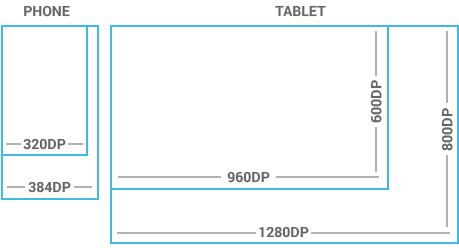
The range of Screens Applicable
Right from Android 1.six, There was open to various screen sizes and densities, putting forth the different screen configurations that a device can support. Yous can UTILIZE THE USER-CENTRIC FEATURES of the Android system to all-time optimize your app'southward UI for each screen configuration to make certain that the design is outstanding for the app also the user experience is made powerful for each screen.
What the Android team did is they looked at the unlike screens bachelor and created 6 logical density buckets to group the different screen densities.
At that place will listing only 5, because i 1 of them, the depression-density bucket (~120 DPI) is not very common anymore:
- mdpi (medium)~160dpi;
- hdpi (loftier)~240 dpi;
- xhdpi (extra-high)~320 dpi;
- xxhdpi (extra-extra-high)~480 dpi;
- xxxhdpi (actress-extra-extra-high)~640 dpi.
The unified sizes and densities involve a baseline configuration that includes normal size and mdpi (medium) density.
The medium density saucepan is the baseline density, the 1x density, and all the other densities are calculated using ~160 DPI as a baseline.
By mode of illustration, 2 devices that meet requirements for screen size and really match factual screen sizes and attribute ratios may exist slightly measured by hand. Notation that Android makes these variations abstract to applications to render UI every bit per generalized sizes and densities, and leaves it for the system to make any concluding adjustments if required.

Equally you lot become through designing for different UIs on multiple screens, you will find that each design requires a minimum amount of space. Then, each generalized prepare requires a minimum resolution that is well-marked by the organisation. These minimum sizes are too in dp units to exclude any trouble while changing in screen density.
- X Large screens are minimum 960dp 10 720dp
- Large screens are minimum 640dp ten 480dp
- Normal screens are minimum 470dp x 320dp
- Small screens are a minimum of 426dp 10 320dp
During execution time, the system uses the most suitable resource for your application equally per the detail device screen'due south generalized size or density. The organisation provides powerful consistent features that can regulate most of your application work on multiple screens considering your UI techniques allow resizing easily.
Using Vector Assets
Vector graphics provide numerous advantages, specially when developing for mobile devices in a constantly expanding assortment of unlike screen sizes and pixel ratios:
- Sharp epitome, regardless of resolution or pixel ratio
- Smaller file size (for the most part)
Of course, vector formats are only suitable for non-bitmap content, e.grand., icons.
Vector images resize gracefully; they draw the image over an abstract sheet size. You can scale this sail up or downwardly and and so redraw the prototype at that size.
Because vector assets resize gracefully, you can include a single asset, safe in the knowledge that it will work on any and all screen densities.
In this article, we wanted to give you a basic understanding of the dimensions & resolution of iOS and Android app design. It tin can be used as a guide to successfully modify your application'southward appearance on unlike screen configurations and provide an optimized feel to the users. To make a mobile application or to order its evolution depends on y'all. Here you will find information almost How Much Will My App Price?
Tired of technical specifications? Schedule a consultation with our developers
Content creator
With more 3 years of experience in creating content of various kinds, I am still fond of investigating unknown and trendy areas, especially technological innovations and discoveries that aim to simplify and automate businesses of different industries, specifics and sizes.

What Resolution Should I Use For A Phone Game,
Source: https://www.altamira.ai/blog/dimensions-resolution-for-ios-and-android-app-design/
Posted by: lewisrearach00.blogspot.com
0 Response to "What Resolution Should I Use For A Phone Game"
Post a Comment